
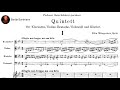
Felix Weingartner (1863-1942) wrote his extraordinary and highly original Quintet for Clarinet, Strings, and Piano in 1911. He was at the height of his powers as a composer. The Quintet begins with a restless Allegro non troppo, ma con brio in which the clarinet presents the main theme over a very restless, repeating, chromatic accompaniment in the strings and piano. A second subject is broad, more lyrical, and brighter. The next movement, Tempo di menuetto, molto moderato, is not a minuet at all, but a kind of intermezzo, at times spooky, at other times playful and lyrical. Later comes a march-like episode introduced by the cello and then taken over by the clarinet and eventually the others. The music resembles a walk through a house of mirrors at a carnival, with so many different episodes and moods. Third comes an Adagio. It, too, begins in a slightly spooky fashion as the clarinet brings forth the main theme over the tremolos in the strings. Tremolos features quite prominently throughout, and along with considerable chromatic writing and trills in the clarinet, gives the music a rather unsettling quality. The finale, Allegro molto, begins in ominous fashion with a lopsided, syncopated witches' dance. Again, there is much downward chromaticism. Dark and brooding, here and there the sun shines through the clouds, but only briefly.
Weingartner was born in Zara, Dalmatia, today's Zadar in Croatia, to Austrian parents. In 1883, he went to the Leipzig Conservatory, where he studied composition with Carl Reinecke. He also studied privately with Franz Liszt in Weimar. Weingartner was one of the most famous and successful conductors of his time, holding positions in Hamburg, Mannheim, Danzig, Munich, Berlin, and Vienna, where he succeeded Gustav Mahler as Director of the Imperial Opera. Despite his demanding career as a conductor, Weingartner, like Mahler, thought of himself equally as a composer and devoted considerable time to composition. He wrote several symphonies, numerous operas, some instrumental concertos, and a considerable amount of chamber music, including four string quartets, a piano sextet, and a string quintet. Additionally, he wrote a great number of vocal works and instrumental sonatas. Though many of his works originally achieved a fair amount of acclaim, they quickly disappeared from the concert stage. It is only in the past few years that their excellence has been rediscovered.
This is a superb work. There is really nothing at all like it in the chamber music literature. Not a work for beginners, but a work which is sure to triumph in the concert hall. Out of print for a century, this is your opportunity to play an exciting and satisfying early modern work of the first order.

