
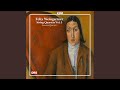
The well-known chamber music critic Wilhelm Altmann, writing in Cobbett’s Cyclopedic Survey of Chamber Music and the Handbook for String Quartet Players, notes that the originality of Felix Weingartner’s chamber music is such that it deserves the attention of both artists and amateurs.
"The originality of Weingartner’s chamber music is such that it deserves the attention of both artists and amateurs. His form and structure are admirable, and his remarkable ability is employed with excellent taste. Weingartner's Second String Quartet was published in 1900. It is a work animated by a fiery spirit that holds one's attention from start to finish. The magnificent outer movements are so fine that they qualify to be ranked among the very best of quartet music and irrefutable proof of his wealth of ideas."
The powerful energy of the opening movement, Allegro deciso, recalls the opening movement of Beethoven’s own quartet in f minor, Op.95. The highly original second movement, Allegretto quasi scherzando, creates an otherworldly atmosphere through the use of exotic tonal effects such as ponticello bowing and the interesting use of pizzicato. The very expressive trio section provides a marvelous contrast to the scherzo. Next comes a Fantasia—Adagio cantabile, non troppo lento. Lyrical and highly expressive, the first violin is given the lead throughout. The exciting finale, Vivace furioso, is inspiring and original and leaves a deep impression.
Felix Weingartner (1863-1942) was born in Zara, Dalmatia, today's Zadar, Croatia, to Austrian parents. In 1883, he went to the Leipzig Conservatory, where he studied composition with Carl Reinecke. He also studied privately with Franz Liszt in Weimar. Weingartner was one of the most famous and successful conductors of his time, holding positions in Hamburg, Mannheim, Danzig, Munich, Berlin, and Vienna, where he succeeded Gustav Mahler as Director of the Imperial Opera. Despite his demanding career as a conductor, Weingartner, like Mahler, thought of himself equally as a composer and devoted considerable time to composition. He wrote several symphonies, numerous operas, some instrumental concertos, and a considerable amount of chamber music, including four string quartets, a piano sextet, and a string quintet. Additionally, he wrote a great number of vocal works and instrumental sonatas. Though many of his works originally achieved a fair amount of acclaim, they quickly disappeared from the concert stage. It is only in the past few years that their excellence has been rediscovered.
Weingartner's style shows the influence of Wagner and combines late Romanticism with early Modernism. It can be said to share a great deal in common with such contemporaries as Richard Strauss and Mahler. Here is a first-rate quartet, written in a very original idiom from a rare, but important transitional era. Out of print for many years, we hope professionals and amateurs alike will make its acquaintance.

